
Success (of sorts)!
ARS Electronica have given an award to Tim Berners-Lee and CERN for the invention of the web. They had heard via a friend at CERN that I had shown the room where the web was developed and explained the story, that the existing commemorative plaque was outside where the web was developed, not where it was invented and where the first web server was located.
They insisted that their plaque go outside the latter location, which means that there is now a plaque outside the room where the web was invented, making it much more likely that it will survive any accidental renovation.
[ Update, April 2013. Save the Room ]
CERN have just announced that they are re-hosting the first web page. It would be great to take this further and host the original web server in the room where it was first located.
I have been trying to pitch this to people at CERN but haven’t managed to persuade anyone yet, and since the room is used as general office space at CERN its is in danger of being refurbished or changed.
Why would you want to do this?
To celebrate the invention of the Web is to celebrate knowledge, its not a piece of religious of political heritage but something that everyone can be a part of. Unlike many other inventions it has a known location and that location is currently unchanged, but there is nothing to protect it.
I suspect that in 100 years, CERN’s legacy as the birthplace of the web will surpass the discovery of the Higgs, W or Z bosons. The web will have had an impact on every day life which could be compared to that of printing, in which case this location could be compared to Guttenberg’s workshop, which had to be reconstructed many years after, when people realized its importance, too late.
Now you could argue that the web is not as important as the invention of printing (I disagree) but its certainly up there with say a major artist’s studio. In which case, consider the extraordinary length’s taken to preserve the floor in Jackson Pollock’s studio and consider that the room where the web was invented is treated just like any other room.
What could be done?
Space is scarce at CERN, and expense has to be justified, so one way of preserving this room would be to make the occupant have some knowledge of its significance and some relevance to it. When I first visited the room the person using it was a computer guy who did not know what had happened there and was very excited to find out. So that would be enough – that the occupant was a computer scientist and that the room was not to be altered.
Taking this a bit further, perhaps a computer scholarship could be created to fund the occupant of the room to do something that takes the spirit of the web further. Perhaps the original web server could be relocated to the room and it could be explored by mapping it on say Google Streetview, so that everyone could visit it. Further still, there are the rooms where the project for the web was developed, these are also historically important.
If you believe, like I do, that preserving the location of the invention of the web would be a good idea, make yourself heard. Tweet to @CERN with this url and the hashtag #savetheroom.
Save The Room!
[ Update, Jan 2012: One of the more interesting consequences of the details below, that hasn’t been picked up anywhere, is that technically the web was invented in France, not Switzerland.]

The blue marker on the map above shows building 31. Note where the border is.
I’ll bet if you asked every French politician where the web was invented not a single one would know this. The Franco-Swiss border runs through the CERN campus and building 31 is literally just a few feet into France. However, there is no explicit border within CERN and the main entrance is in Switzerland, so the situation of which country it was invented in is actually quite a tricky one. The current commemorative plaque, which is outside a row of offices where people other than Tim Berners-Lee worked on the web, is in Switzerland. To add to the confusion, in case Tim thought of the web at home, his home was in France but he temporarily moved to rented accommodation in Switzerland, just around the time the web was developed. So although, strictly speaking, France is the birthplace of the web it would be fair to say that it happened in building 31 at CERN but not in any particular country! How delightfully appropriate for an invention which breaks down physical borders. ]
I wrote to Tim Berners-Lee after exploring CERN looking for the location where the web was invented. His replies regarding the exact locations are below (I’ve put up photos of the excursion as an Oobject list, here ).
There is a plaque in a corridor in building 2, but no specific offices are indicated and there is some ambiguity as to what happened where, in building 31. Thomas Madsen-Mygdal has a gallery showing locations in building 31 and 513, but there are very few places on the web documenting these places. I took photos of the plaque, such as the one here, with Creative Commons licenses, so that they could be used elsewhere.
The reason I’m interested in this is that recognizing the exact places involved in the birth of the web is a celebration of knowledge itself rather than belief, opinion or allegiance, both politically and spiritually neutral and something that everyone can potentially enjoy and feel a part of.
Secondly, many places of lesser importance are very carefully preserved. The place where the web was invented is arguably the most important place in 2 millennia of Swiss history and of global historical importance.
Lastly, this kind of information is perhaps overlooked as being so obvious as to be common knowledge, exactly the sort of thing that sometimes gets forgotten. I’m not suggesting that the locations have indeed been overlooked, but they are not preserved or all indicated and the people I spoke to didn’t know the full details. So just in case…
DG: Where were you (at CERN and which building/rooms or home) when you thought of or were writing the original proposal for the web in 1989?
TBL: I wrote the proposal, and developed the code in Building 31.
I was on the second (in the European sense) floor, if you come out of the elevator (a very slow freight elevator at the time anyway) and turn immediately right you would then walk into one of the two offices I inhabited. The two offices (which of course may have been rearranged since then) were different sizes: the one to the left (a gentle R turn out of the elevator) benefited from extra length as it was by neither staircase nor elevator.
The one to the right (or a sharp R turn out of the elevator) was shorter and the one I started in. I shared it for a long time with Claude Bizeau.
I think I wrote the memo there. [ dg: proposal for the web was written, i.e. web was ‘invented’ in room 2-010 ]
When I actually started work coding up the WWW code in September 1990, I moved into the larger office. That is where I had the NeXT machine, as I remember it. [ dg: larger office, i.e. where first web server was and software was written, where web was ‘created’, is room 2-012 ]
The second floor had pale grey linoleum, the first floor, where Peggie Rimmer had her office, had red lino; the third floor had pale yellow lino. The ground floor had I think green lino. Also on the second floor was the Documentation et Données, later Computing and Networking, HQ with David Williams at one point heading it up.
DG: For the development of the web, can you remember which offices were used in building 31 or off the corridor shown in building 2 in the attached image?
TBL: Building 2 I never had an office in. Robert Caulliau did, and various students, including Henrik Frysyk Nielsen and Hakon Lie, and Ari Luotonen, worked there.
DG: Was some of it inspired at home and was that here: Rue de la Mairie, Cessy (France)?
TBL: My house was [exact address removed since people live there] Rue de la Mairie, but I rented it out for some time around 1990 and actually lived in Les Champs Blancs, Chavannes de Bois [Switzerland]. But then we moved back to Cessy for a year before leaving.
[ Update: I went back and took some pictures (Creative Commons license so you can use them) of the room where TBL created the original proposal for the Web. And have some exciting news to share about it soon! ]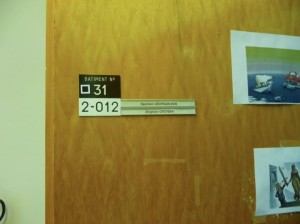
Door to the room where the web was created

The Polish coder who currently occupies the room didn’t know its significance. He was very happy to find out.

Ben Segal who helped setup the original web server in the room where the web was created
[…] David Galbraith, via Kottke: I’ll bet if you asked every French politician where the web was invented not a […]
[…] – The internet: French. […]
I’ll bet, if you ask a Swiss politician, most of them wouldn’t know where the web was invented, either (not even roughly). And if you ask a US politician, he would probably assume it was invented in the US.
In Switzerland, we don’t use to “brag” about inventing the web like many people in the states seem to about them inventing the internet; here, its more of a nerd subject. So the geographical details probably don’t matter that much (but to us nerds).
Also, Geneva (the “state” where CERN belongs to) didn’t belong to Switzerland before 1536 and Switzerland didn’t exist at all before 1291. Sure, the land existed and there were people, but it wasn’t Switzerland and what happened there isn’t a part of Swiss history. This might be a bit hard to understand for someone living in a place that never really changed countries…
My point: the importance of inventing the web as a part of Swiss history is probably exaggerated. “2 millennia” simply makes no sense (why not write 5 millenia?) and there were events (arguably) considered much more important than inventing the web, like, for example, Einsteins work. (Thats something the Swiss like to brag about. We also invented LCD screens and LSD ^^)
@Stephan. Very true, I am based in Geneva and the line I always use to combat the ‘Third Man’ initiated myth that Switzerland is dull and uninventive is that Switzerland didn’t invent the cuckoo clock (the Germans did) but it did invent acid.
Although some structures are located on French territory, the entire CERN site is under Swiss administration. However, due to a special treaty, the site is under no national jurisdiction (neither French nor Swiss). So the Internet was born on international grounds.
One thing however is notable: The largest funder of CERN has always been Germany (with a 20% share in 2010), so you can safely say that, wherever it was actually invented, the Germans certainly paid for it 😉
[…] Galbraith wrote to Tim Berners-Lee, the inventor of the World Wide Web, who explained that the Web was […]
[…] ha indagato e, intervistando Tim Berners-Lee, ha scoperto che il WWW è nato a cavallo di Francia e Svizzera. I laboratori nei quali fu […]
[…] Fascinating story today from David Galbraith, trying to track down the precise geographical location where Tim Berners-Lee invented the Internet. Was it at his office, and if so, was his office in France or Switzerland (the CERN campus straddles the border)? Was it at his house in France, or a place he lived temporarily in Switzerland? Read all about it here. […]
[…] Galbraith has done some fantastic investigative work about the exact birthplace of the Internet: “The Franco-Swiss border runs through the CERN campus and building 31 is literally just a […]
[…] Das World Wide Web wurde genau genommen in Frankreich und nicht in der Schweiz erfunden.» Tim Berners-Lee. Confirming The Exact Location Where the Web Was Invented Nuklearkraft Und 20 Jahre später sinniert Peter Glaser sehr poetisch über die Auswirkungen […]
[…] David Galbraith’s Blog » Blog Archive » Tim Berners-Lee. Confirming The Exact Location Where the… The Web was invented in France, on a NeXT. […]
[…] ha indagato e, intervistando Tim Berners-Lee, ha scoperto che il WWW è nato a cavallo di Francia e Svizzera. I laboratori nei quali fu […]
[…] a details. For it is by investigate efforts like this that we get to find out accurately where a creation happened. I’ll gamble if we asked each French politician where a web was invented not a singular one would […]
[…] Tim Berners-Lee. Confirming The Exact Location Where the Web Was Invented: Σε ποιο δωμάτιο – γραφείο του CERN δημιουργήθηκε το World Wide Web; Όπως επίσης σε… ποια χώρα δημιουργήθηκε. […]
I don’t see why it matters as CERN is a joint European venture anyway.
Well the fact that it was invented in a part of France that you can only get to from Switzerland hopefully creates enough ambiguity that that’s exactly what happens – it was neither invented in Switzerland or France but at CERN.
This is exactly the point I was trying to make, that without this fuzzy reality a country would be able to claim it.
[…] Le Web a été inventé en France – David Galbraith […]
[…] a web application | Internet Pawn | Tech Crunch | The Big Apple | Demystifying-Demistifying | Tim Berners-Lee. Confirming The Exact Location Where the Web Was Invented | Ten things that defined the noughties | Social networks and creativity | Imagining the iPad | […]
אולם אירועים…
[…]David Galbraith’s Blog » Blog Archive » Tim Berners-Lee. Confirming The Exact Location Where the Web Was Invented[…]…
[…] Fascinating story today from David Galbraith, trying to track down the precise geographical location where Tim Berners-Lee invented the Internet. Was it at his office, and if so, was his office in France or Switzerland (the CERN campus straddles the border)? Was it at his house in France, or a place he lived temporarily in Switzerland? Read all about it here. […]
[…] wurde der 6.8. in Erinnerung an die erste Internetseite, die Tim Berners-Lee im Jahre 1991 am CERN aller Welt verfügbar […]
[…] an den Geburtstag des Webs gefeiert. Das war jener Tag an dem Tim Berners-Lee im Jahre 1990 am CERN die erste Webseite über das Internet verfügbar machte. Das Ziel dieses Netzkulturtages lassen wir […]
[…] of Berners-Lee’s work reflects well on Great Britain, but then it also is a credit to France the actual place from whence he didst build the first website. Go […]
That plaque is actually in building 1 (just outside my office).
[…] pointed out by Reg reader Jonathan: “The precise location at CERN is apparently an office in France with its entrance in Switzerland.” […]
[…] Galbraith is pushing CERN to celebrate the Web’s origins a bit further than just a web […]
[…] [1] Tim Berners-Lee’s account of the exact locations at CERN where the Web was […]
[…] Galbraith is pushing CERN to celebrate the web’s origins a bit more than just with a web page. Perhaps a computer […]
[…] Galbraith is pushing CERN to celebrate the web’s origins a bit more than just with a web page. Perhaps a computer […]
[…] Galbraith is pushing CERN to celebrate the web’s origins a bit more than just with a web page. Perhaps a computer […]
[…] David Galbraith lleva un par de años haciendo arqueología digital en un esfuerzo por encontrar y preservar la oficina en la que se inventó la web: […]